Seller guide
How to read a reel tag and jacket print
Three photographs and five minutes of reading will identify almost any reel well enough to review it properly. This is what to look for.
Sell your surplus wire — request a quote Call +1 (614) 715-3047
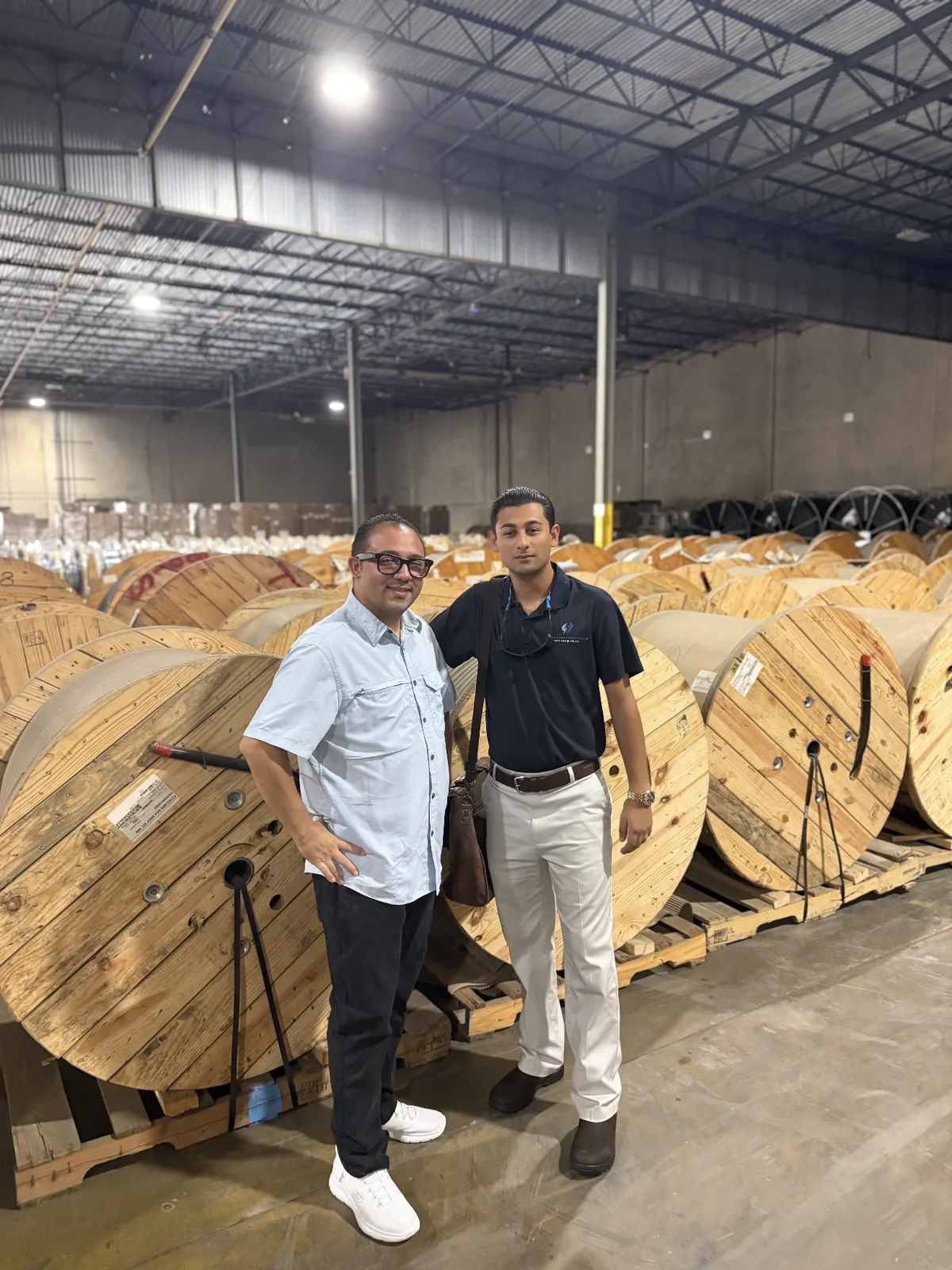
Most disagreements about surplus wire come from identification, not from condition. A reel that is correctly identified is easy to review; the same reel described from memory is a series of questions. This guide covers what to photograph and how to read it.
1. The reel tag
Most factory reels carry a tag or label on the flange, sometimes stapled, sometimes under a plastic sleeve. It usually shows:
- ManufacturerBrand and plant
- Product typeTHHN, XHHW-2, TC-ER…
- SizeAWG or kcmil
- ConductorsCount and configuration
- Put-upFeet or metres on the reel
- Voltage600 V, 1 kV, 15 kV…
- Lot or dateProduction reference
- ListingsUL, CSA, sunlight resistant
Photograph the whole tag, then a second shot of just the size and put-up figures. If the tag is damaged, photograph the damage — a partial tag is still evidence.
2. The jacket legend
The print running along the jacket repeats the same information. Read it in order: conductor size, conductor count, insulation type, jacket type, voltage rating, temperature rating, listing marks and any special ratings such as sunlight resistant, direct burial or tray rated.
| Meaning | Why it matters | |
|---|---|---|
| THHN / THWN-2 | Thermoplastic, nylon jacket, 90°C | Dual-rated wire travels between jobs |
| XHHW-2 | XLPE insulation, wet or dry | Higher-value wet-location stock |
| TC-ER | Tray cable, exposed run | Can leave the tray without conduit |
| USE-2 | Underground service | Direct burial rating, UV limits |
| MC / HCF | Armored, hospital grade | Ground path and healthcare use |
| EPR / XLPE | MV insulation types | Determines voltage class and reuse |
3. Sizes: AWG and kcmil
Small conductors are AWG, from #14 up to #1, then 1/0, 2/0, 3/0 and 4/0. Above that, sizes are in kcmil (thousands of circular mils), often written MCM: 250, 300, 350, 400, 500, 600, 750 and 1,000.
| Size | Typical use | Note |
|---|---|---|
| #14 – #10 | Branch circuits, control | Most common contractor partials |
| #8 – #6 | Subpanels, equipment drops | Frequently over-bought |
| #4 – #1 | Feeders, service work | Good resale if tagged |
| 1/0 – 4/0 | Services, large feeders | Copper and aluminum differ sharply |
| 250 – 500 kcmil | Switchgear, transformers | Matched sets are common |
| 600 – 1,000 kcmil | Heavy distribution | Handling becomes the constraint |
4. Conductor count and configuration
Single-conductor cable is one insulated conductor per reel. Multi-conductor cable is described as a count plus a ground, for example 3 conductors plus ground, or 4-4-4-6 for a SER assembly. Control cable is usually described by conductor count and gauge, such as 12 conductor #16, with pairs and shields noted separately.
5. Footage, honestly
A factory reel has a printed put-up: 500 ft, 1,000 ft, 2,500 ft, 5,000 ft. Once a reel is opened, the remaining length is an estimate unless it was measured. Useful evidence includes the printed put-up, the wire level against the flange, a wrap count, or a measured length if the reel was respooled. Mark it as an estimate and the review will treat it as one.
6. Condition checks worth doing before you submit
- Jacket: cracks when bent, chalky surface, abrasion through to the conductor.
- Ends: water inside the jacket, corrosion on exposed copper, taped or open.
- Reel: broken flange, rot, bent steel core, wire crushed against the flange.
- Storage: indoors or outdoors, on dunnage or on the ground, upright or on its side.
7. How to photograph a lot
- One wide shot of the storage area, so the scale is clear.
- One shot per reel group, with the tag visible.
- One close shot of the jacket print, in focus, with enough length to read.
- One shot of the cut end for any opened reel.
- One shot of any damage, and one of the loading access.
Do not re-spool or cut cable to photograph it. A clean cut end is useful only where the reel is already open. Cutting a sealed reel changes what it is and removes the evidence you were trying to capture.
Questions sellers ask
Questions about this material
What if the reel tag is missing entirely?
Use the jacket print. If that is also unreadable, the material is reviewed as unidentified: measure the conductor, photograph the cut end, and include any purchase records you have.
Does the tag have to be factory-original?
It does not have to be pristine, but it does have to be original to the reel. A hand-written label added later is treated as a claim rather than as evidence.
Can I estimate footage from the reel diameter?
Roughly, and only if the put-up and conductor size are known. It is an estimate; say so. A measured length or a printed put-up is always better.
Keep reading
Quote request
Sell your surplus wire — request a quote
Describe the lot as it actually sits. Photos of the reel tag and jacket print do more than any description, and mixed or unidentified cable can still be submitted for review.
Identified the material? Send it here.